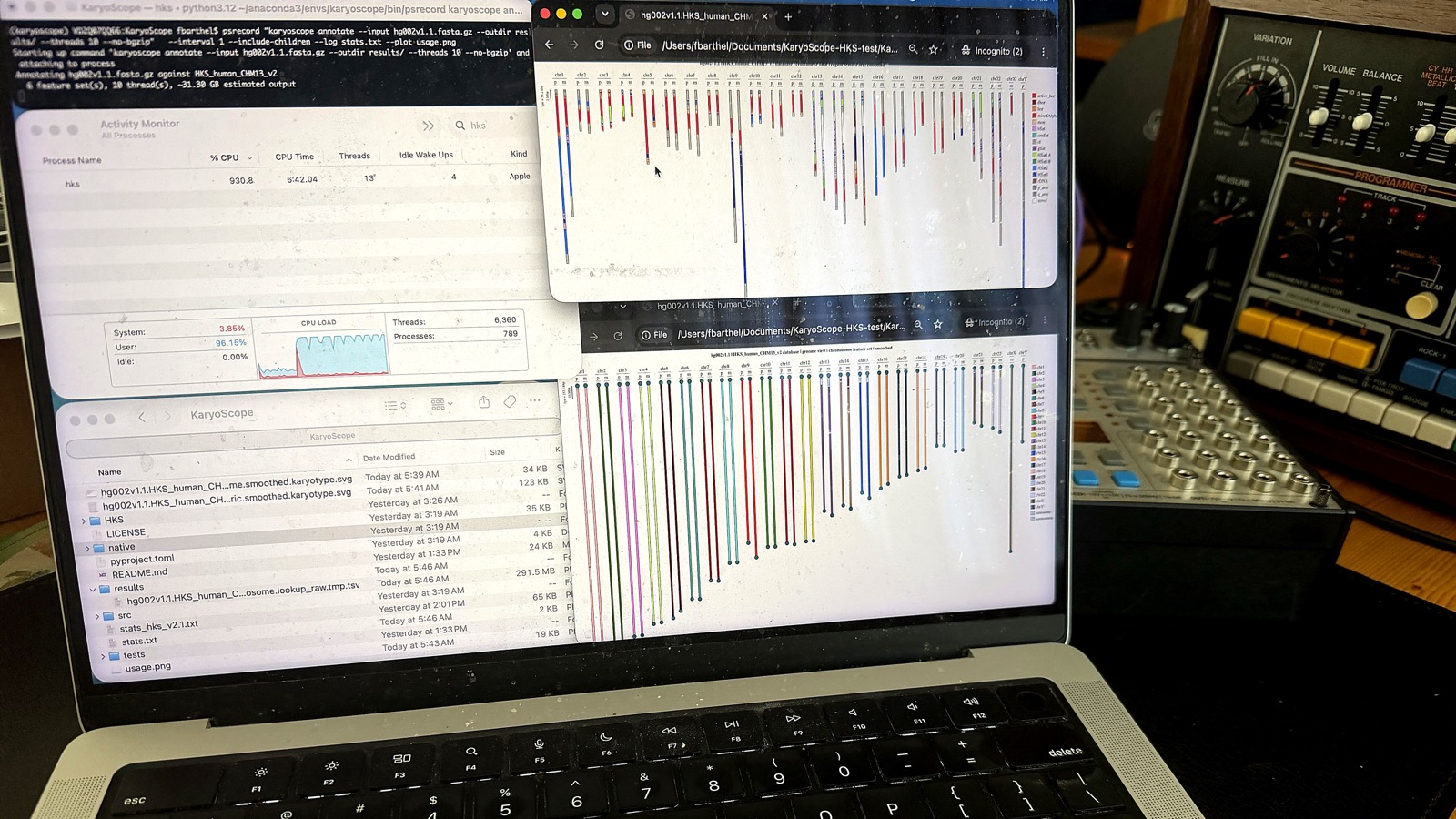
Excited to share a big KaryoScope update this past week: the HKS k-mer backend is now integrated, and you can build databases for any features of interest. The complete Human Pangenome Reference Consortium HG002 assembly (~6.3 Gbp) now annotates in 21 minutes on a MacBook Pro.
Some run statistics: peak 941% CPU across 10 threads, peak 10.2 GB RAM on an M1 Max. Broad plateaus are k-mer lookup, sharp bursts are hierarchy-aware smoothing, and each of the six feature sets appears as its own block.
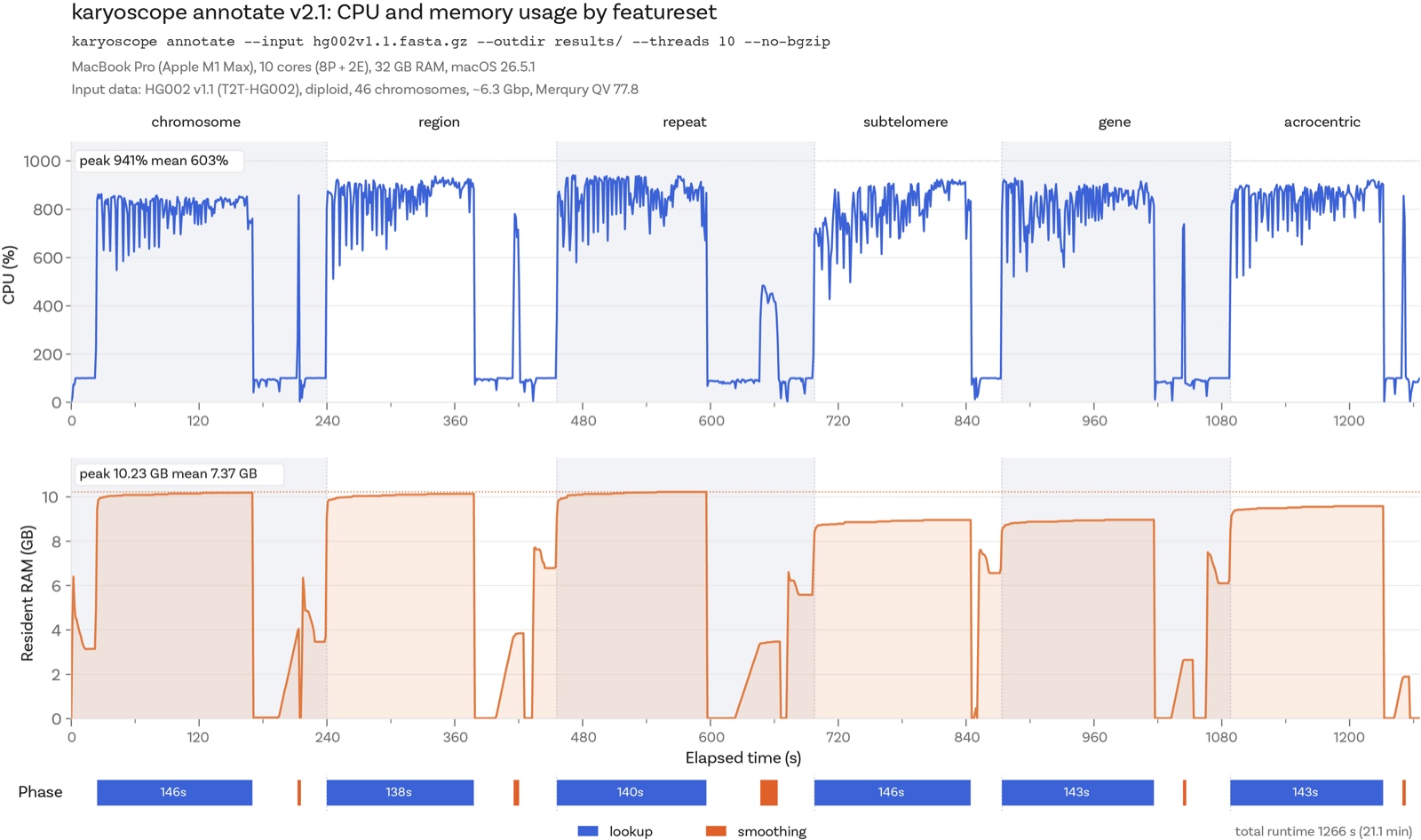
Per feature set the cost is remarkably flat: 138 to 146 s of lookup each (chromosome, region, repeat, subtelomere, gene, acrocentric), plus a brief smoothing burst. Runtime scales linearly with feature sets queried. Try it yourself.
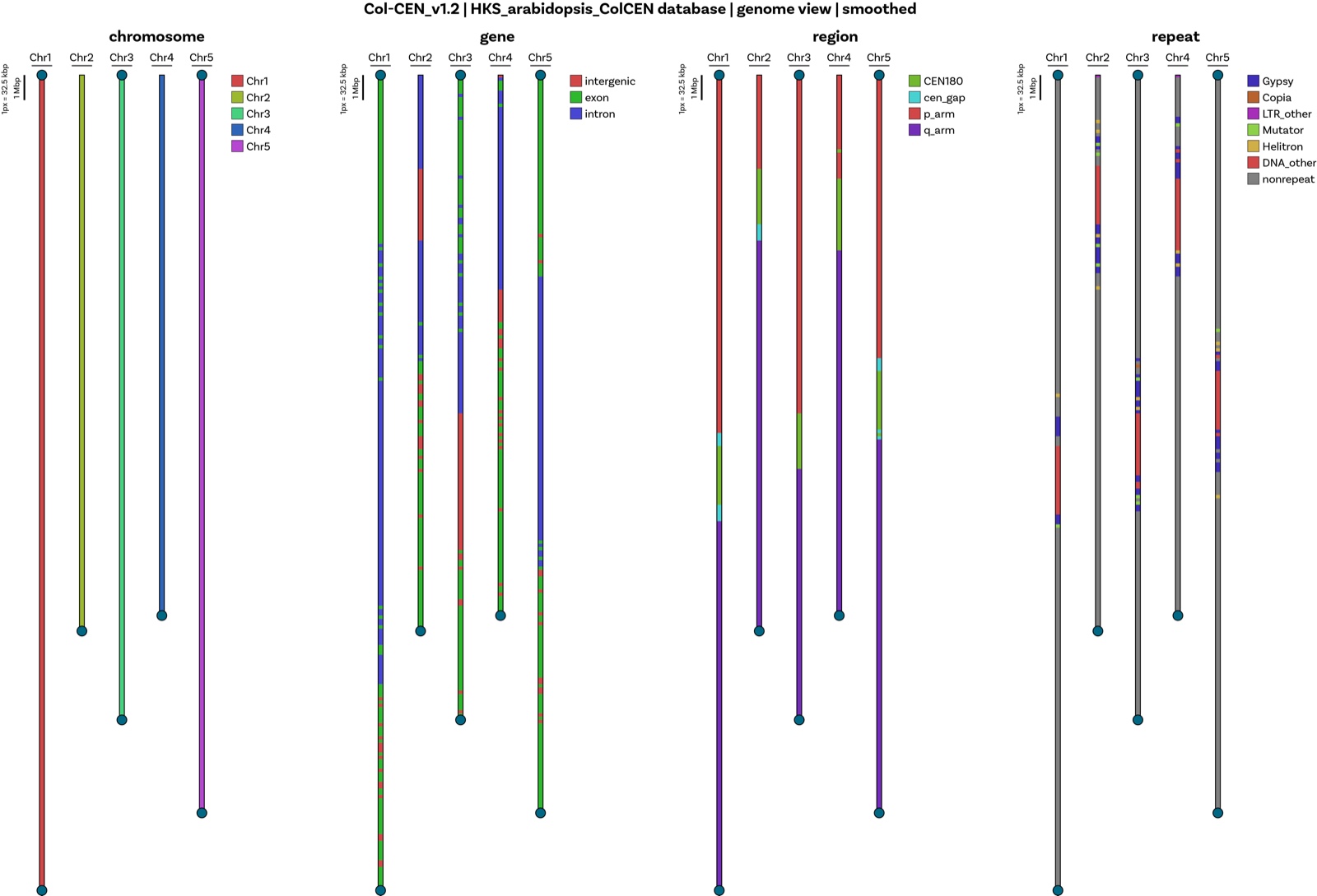
Feature sets are not tied to a genome: any annotation that tiles a reference can become one. Here is a database we built for the Arabidopsis Col-CEN T2T reference, with chromosome, gene, region, and repeat feature sets, including the CEN180 satellite arrays.
Getting KaryoScope off the cluster and onto a personal computer is a milestone we cared about. Genome analysis belongs to everyone, not just institutions and corporations that have the resources to maintain high-performance compute clusters.
The improved HKS index was developed by Jarno Alanko, Camille Marchet and Simon Puglisi. KaryoScope and its original KMC-derived data structure were developed by Rhyker, with our co-authors and the Human Pangenome Reference Consortium.
If you build a KaryoScope database for your organism of interest, we would love to hear about it.
Read more: the HKS paper · the KaryoScope paper · the code on GitHub